NASA Launches Roman Space Telescope
Mission Begins Million-Mile Journey to Deep Space
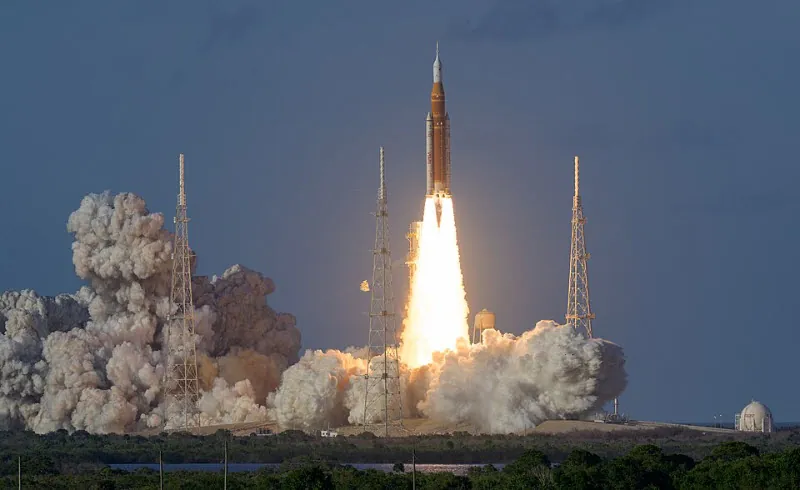
NASA's Nancy Grace Roman Space Telescope successfully launched aboard a SpaceX Falcon Heavy rocket on August 30 from Launch Complex 39A at Kennedy Space Center in Florida, beginning a mission designed to study dark energy, dark matter, the evolution of galaxies, and planets beyond our solar system. The $4.3 billion observatory lifted off at 7:26 a.m. EDT, separated from the rocket's upper stage about 31 minutes later, deployed its solar arrays, and established communications with mission controllers at NASA's Goddard Space Flight Center in Maryland.
The 18,000-pound spacecraft is now traveling nearly 1 million miles to the Sun-Earth Lagrange Point 2 (L2), where it is expected to arrive after a journey of about three months. Named for Dr. Nancy Grace Roman, NASA's first chief astronomer, the observatory carries a 2.4-meter primary mirror and a 300-megapixel Wide Field Instrument capable of capturing infrared images covering an area roughly 100 times larger than the Hubble Space Telescope in a single observation. Roman also includes a Coronagraph Instrument that will demonstrate advanced technology for directly imaging planets orbiting distant stars.
Mission scientists expect Roman to conduct a five-year primary science mission after completing in-space testing and calibration. The telescope will survey vast regions of the universe to better understand how cosmic expansion has changed over billions of years, helping scientists investigate the nature of dark energy. It will also search for thousands of exoplanets using gravitational microlensing while mapping large-scale cosmic structures with unprecedented efficiency.
Roman complements existing observatories rather than replacing them. While Hubble excels at detailed observations of individual objects and the James Webb Space Telescope focuses on deep infrared studies of specific targets, Roman is designed to rapidly survey enormous portions of the sky, providing data that can identify new discoveries for follow-up observations by other telescopes. Scientists believe the mission could significantly expand understanding of the universe's composition and evolution over the coming decade.