Starship reaches Earth orbit for first time on 14th test flight
SpaceX deploys 26 operational Starlink satellites before Pacific return
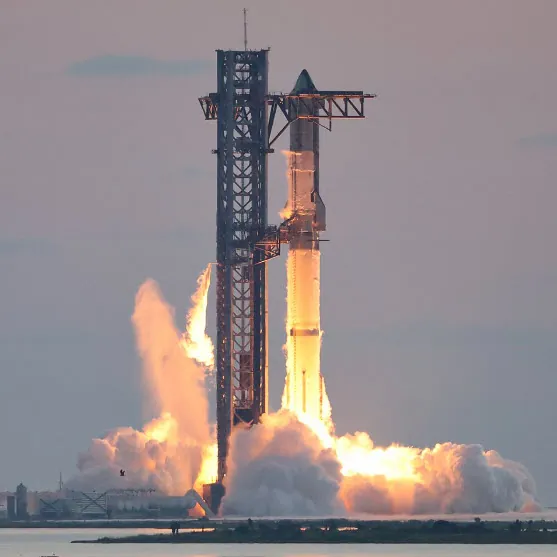
SpaceX's Starship reached Earth orbit for the first time Monday on its 14th integrated test flight, marking a major milestone for a rocket that has been launched repeatedly since flight testing began in 2023. Earlier Starship missions had traveled into space and reached near-orbital speeds, but followed suborbital trajectories rather than entering a sustained Earth orbit.
Starship lifted off from Starbase, Texas, on September 28 atop its Super Heavy booster. One of the upper stage's six Raptor engines shut down early during ascent, but after reviewing telemetry, flight controllers determined the spacecraft was healthy enough to continue. A later engine firing completed the orbital insertion, placing Starship roughly 275 kilometers above Earth.
Once in orbit, Starship deployed all 26 next-generation Starlink V3 satellites, marking the first time the vehicle carried an operational payload into orbit. Previous Starship flights had tested satellite deployment using non-operational Starlink simulators, making Monday's mission another significant step toward using the massive rocket for routine launches.
The flight was originally planned to last nearly 10 hours and complete about six orbits. SpaceX instead brought Starship home after roughly three hours, saying the shortened mission was chosen out of an abundance of caution following the engine problem during ascent. The spacecraft survived atmospheric reentry and reached the Pacific Ocean north of Hawaii, where it splashed down and was lost as planned. The Super Heavy booster separately performed its return maneuvers and made a controlled splashdown in the Gulf of Mexico.
Reaching orbit is important because SpaceX ultimately intends Starship to become a fully reusable transportation system for satellites, cargo and crews. NASA also plans to use a modified Starship as the lunar lander for future Artemis missions. Major development challenges remain, including demonstrating orbital refueling and routinely recovering and reusing both stages.